louvre.travelOpens tomorrow at 9:00Closed now
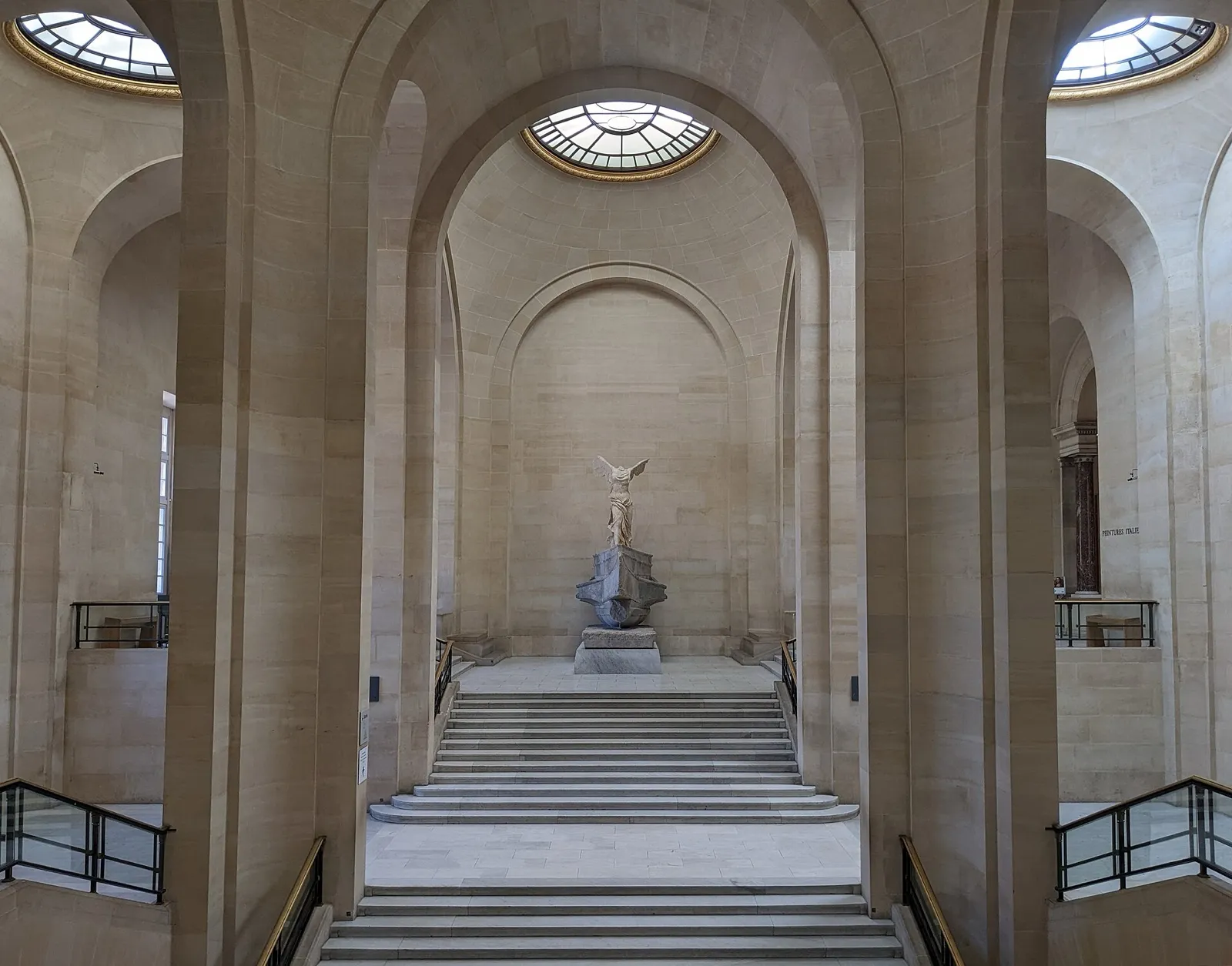
The Winged Victory of Samothrace at the top of the Daru staircase in the Louvre

Winged Victory of Samothrace

The Winged Victory stands at the top of the Daru staircase, Room 703, on level 1 of the Denon wing. The statue is 328 cm high and rises to 564 cm with its ship and plinth.

Photo: Shonagon, CC0

Checked on 14 November 2026

Winged Victory room
Room 703

The Daru staircase, Denon wing, level 1.

Height of the statue
328 cm

564 cm with the ship and the plinth it stands on.

Louvre ticket
€32

The museum ticket covers it. €22 for residents and citizens of the European Economic Area.

More

The museum's trail reaches the Daru staircase through Room 347 and the rotunda. Climb to Room 703, on level 1 of the Denon wing.

The staircase

Where is the Winged Victory of Samothrace in the Louvre?

At the top of the Daru staircase, Room 703, on level 1 of the Denon wing. The staircase is one of six grand staircases the architect Hector Lefuel built in the palace, and it leads in four directions on three levels.

The 90-minute Louvre's Masterpieces trail includes the statue as step 3 of 12. From the Venus de Milo, it crosses Room 347 and the rotunda before climbing the Daru staircase. This route uses stairs; a step-free route to Room 703 is not confirmed.

The museum says the figure was made to be seen in three-quarter view, from her left-hand side. From the landing the trail goes on to the right, between the columns, to the Botticelli frescoes in Room 706.

What to do: Look at the statue from her left-hand side. The museum describes a three-quarter view as the angle it was designed for.

The statue

What is the Winged Victory of Samothrace?

It shows Nike, the Greek goddess of victory, about to land on a ship. The museum says it probably dates to 190 BC; the catalogue gives the first quarter of the 2nd century BC. It was commissioned to celebrate a victory at sea; the museum names no sculptor.

The statue is carved in Parian marble; the ship and the plinth are in grey Lartos marble. It was an offering for a sanctuary on the Greek island of Samothrace, where it stood high up and could be seen from afar. That is why the museum placed it at the top of a staircase.

The wings were partly recovered and completed in plaster. An 18-month conservation and cleaning project on the statue and its ship ended in 2014.

The find

How was the Winged Victory of Samothrace found?

About 110 fragments, with no head or arms, were unearthed on Samothrace by Charles Champoiseau in 1863.

The recovered plinth and ship's prow now form the statue's base. The monument was installed on the upper landing of the Daru staircase in 1883.

Parts of the right hand were found in 1875 and 1950. The 27 cm hand is displayed in a small case on the same landing.

What to do: Look for the showcase with the hand on the landing before you move on.

Opening times

When can you see the Winged Victory?

The Louvre opens from 9:00 to 18:00, or until 21:00 on Wednesdays and Fridays; access to Room 703 needs checking. The museum closes on Tuesdays, 1 January, 1 May and 25 December. Last entry is one hour before closing; staff start clearing rooms 30 minutes before.

The room schedule has no entry for the Daru staircase, so it does not confirm daily access to Room 703. You may take photos and videos for personal use in the permanent collections, without selfie sticks, flash or extra lighting.

People also ask

Where is the Winged Victory of Samothrace located?
At the top of the Daru staircase, Room 703, on level 1 of the Denon wing of the Louvre.
How tall is the Winged Victory of Samothrace?
The statue is 328 cm high. With the ship and the plinth it stands on, the monument is 564 cm.
Why does the Winged Victory have no head?
No head was among the roughly 110 fragments found on Samothrace in 1863. How it was lost is not confirmed. Parts of the right hand were found in 1875 and 1950.
Who made the Winged Victory of Samothrace?
The museum names no sculptor. It says the statue probably dates to 190 BC and celebrates a victory at sea. Its catalogue gives the first quarter of the 2nd century BC.
What is the Winged Victory of Samothrace made of?
The statue is Parian marble. The ship and the plinth are Lartos marble, and the missing parts of the wings were completed in plaster.
Can you take photos of the Winged Victory?
Yes, for your own use. Selfie sticks, flash and lighting are not allowed in the permanent collections.

Louvre guided tours

7 picked from 56

Louvre visit guides

  • Louvre tickets

    €32, or €22 for residents and citizens of the European Economic Area. Under 18s enter free with ID.

  • Mona Lisa

    Room 711, the Salle des États, on level 1 of the Denon wing.

  • Louvre opening hours

    9:00 to 18:00, and until 21:00 on Wednesdays and Fridays. Closed on Tuesdays.

Sources checked on 14 November 2026: Louvre: A stairway to Victory, Louvre collections: Victoire de Samothrace, Louvre: The Louvre's Masterpieces trail.